Unified Manufacturing Data Architecture
The UMDA framework
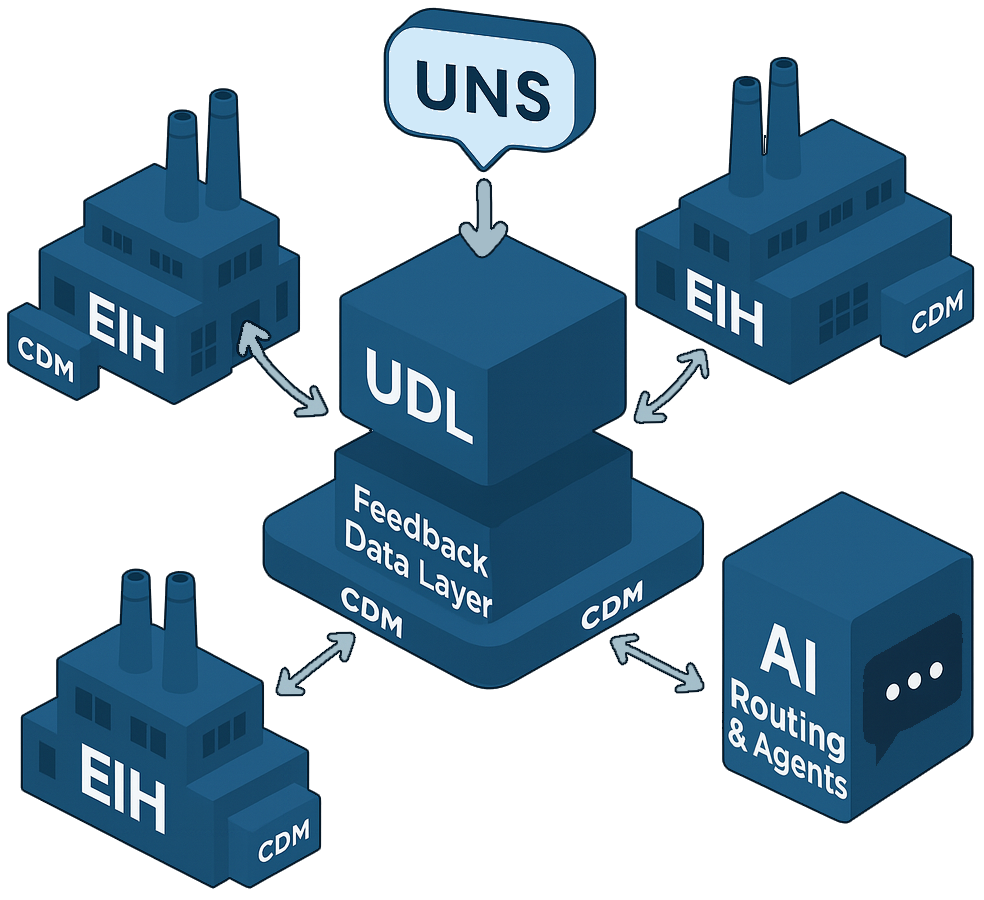
One open, vendor-neutral structure made of six interoperating layers that carry context from the edge to the enterprise, then feed intelligence back again.
Each layer owns a clear contract, governance model, and security posture, and maps to open standards and tools you can already run or buy, with no proprietary core to license.
Explore the six layers
Select a layer to see its role and key capabilities, from the shop floor up to AI.
Edge Intelligence Hub
EIHUMDA's on-premise nerve center. It ingests raw signals, enriches them with site context, enforces local data contracts, and can host lightweight AI models that analyze anomalies or predict failures locally.
- Multi-protocol ingestion — OPC UA, MQTT, Sparkplug B, Modbus, REST, legacy PLCs.
- Low-latency buffer — sub-second caching and store-and-forward survive network drops.
- Inline contract validation — checks shape, units, and timestamps against CDM schemas.
- Context tagging — attaches BatchID, OrderID, EquipmentID via ISA-95 maps.
- Publish to UNS — streams enriched events into Site/Line/Equipment/Event topics.
- Edge ML inference — optional GPU/TPU slot for vibration or vision models.
- Zero-trust gateway — TLS, mutual-cert auth, local secrets vault.
- High availability — active/standby nodes with automatic fail-over.
- Containerized lifecycle — signed images via K3s / Greengrass / IoT Hub.
Common Data Models
CDMEach domain (Quality, Maintenance, Production, Supply Chain) owns a model that standardizes vocabulary, units, business rules, and relationships. It is the ontology, or semantic foundation, that connects edge events to enterprise analytics.
- Domain vocabulary — harmonizes terminology across CMOs and internal sites.
- Ontology & relationships — formalizes domain concepts and how they relate, giving data shared, machine-readable meaning and the schema for the knowledge graph.
- JSON data contracts — enforce schema, units, and latency SLAs per field.
- ISA-95 / ISA-88 mapping — aligns equipment, recipes, lots, and orders.
- UNS topic naming — CDM IDs drive topic hierarchies for zero-copy pub/sub.
- Governance anchor — ownership, lineage, and stewardship tie to CDM tables.
- Master data binding — links ERP materials, suppliers, and specs to live signals.
- Unit conversion rules — canonical units plus on-the-fly conversion.
- AI feature store — versioned tables feed feature-engineering pipelines.
- Version control — history stays queryable after schema evolution.
Unified Namespace
UNSUMDA's real-time event backbone. CDM-tagged messages publish to a hierarchical topic structure (Site/Line/Equipment/Event), enabling zero-copy routing from edge to cloud.
- CDM-aligned topics — names embed BatchID, StageID, EquipmentID for inherited context.
- Zero-copy fan-out — one publish serves MES, historians, agents, dashboards.
- Retained messages — last-known value gives late subscribers instant state.
- Schema registry link — topic-to-CDM mapping stored for lineage.
- Security envelope — TLS, mutual certs, and per-topic ACLs enforce zero trust.
- Backpressure & buffering — EIH store-and-forward protects brokers.
- Cloud bridge — optional connectors replicate topics to public-cloud hubs.
- Metadata topics — health, heartbeat, and contract-version topics.
- Stateless consumers — services restart anywhere without losing sequence.
Unified Data Layer
UDLUMDA's enterprise backbone. It consolidates domain CDMs, preserves full lineage, and exposes governed analytics to every plant, partner, and AI service. Connected, it becomes a knowledge graph: entities and their relationships linked so people and AI can traverse context, not just query tables.
- Knowledge graph — links CDM entities and relationships into a queryable graph (RDF/OWL or property graph) for context-rich traversal and reasoning.
- Cross-site KPI warehouse — OEE, cycle time, yield, and quality across plants.
- Time-series & relational joins — historian signals plus CDM tables for digital-thread queries.
- Governed lakehouse — Parquet/Delta/Iceberg with role-based access and row-level lineage.
- Contract enforcement — validates payloads against JSON Schemas and SLA timers.
- Semantic layer registry — logical models for BI and self-service analytics.
- AI feature store — point-in-time snapshots for training and drift monitoring.
- Streaming & batch APIs — ANSI SQL, GraphQL, and pub/sub endpoints.
- Feedback loop sink — captures FDL outcomes to close the learning cycle.
- Retention policies — tiered storage aligned to GMP/GxP (5, 10, 30 years).
Feedback Data Layer
FDLUMDA's closed-loop memory bank. It captures every AI inference, operator response, and real-world outcome, creating a trusted dataset for continuous improvement and regulatory audit.
- Inference registry — logs model, version, feature hash, confidence, timestamp.
- Human-in-the-loop feedback — records accept/override with reasons and e-signatures.
- Outcome metrics — stores actual results for accuracy back-testing.
- Drift monitoring — captures feature-distribution deltas to flag drift.
- Model lineage — ties predictions to Git commits or ML-flow entries.
- Retraining dataset builder — auto-curates labelled records for retraining.
- Contract evolution insights — surfaces schema mismatches to CDM owners.
- Query & API layer — GraphQL / REST feed BI and MLOps pipelines.
AI Routing & Agents
AIThe router orchestrates tasks across lightweight, domain-specific, and general-purpose models, while autonomous agents use CDM context to detect anomalies, recommend actions, and write results back to the Feedback Data Layer.
- Dynamic model selection — by complexity, domain, latency, and cost.
- Context injection — pulls batch, equipment, and parameter context before prompting.
- Horizontal collaboration — quality, maintenance, supply-chain agents share results.
- Vertical escalation — unresolved edge issues escalate to enterprise models.
- Anomaly detection & RCA — flag deviations and correlate CPPs, lots, work orders.
- CAPA generation — drafts corrective actions routed to approvers via QMS.
- Latency tiers — sub-second at the edge, deeper analysis in the cloud.
- Human-in-the-loop fallback — low-confidence tasks route to SMEs, logged in FDL.
- Policy & guardrails — prompt filtering, PII masking, token-level audit logs.
Each layer below opens up with an interactive deep-dive on this page. Start at the edge and follow the data up the stack.
Layer deep-dive · the edge
Inside the Edge Intelligence Hub
The hub turns raw, multi-protocol signals into enriched, contextualized events, then publishes them to the Unified Namespace. If the network drops, it stores and forwards so nothing is lost.
Click a stage for details, or process a reading to watch it flow. Toggle the network to see store-and-forward.
Try it
Click a stage to see what it does, or process a reading to watch a raw signal become an enriched, contextualized event.
Message
Layer deep-dive · the shared language
Inside the Common Data Model
The same reading arrives named and scaled differently by every system. The CDM maps it to one shared, contextualized entity.
Click any rule in the Common Data Model for details
The Common Data Model turns inconsistent tags from every system into one shared, contextualized entity, with consistent names and units, aligned to ISA-95, and validated by a data contract.
Layer deep-dive · real-time backbone
Inside the Unified Namespace
Every signal lives in one hierarchy. A message is published once and fans out to every subscriber that needs it.
Pick a metric in the namespace to see its message, then publish it
Topic
Sample message
Published once, consumed by
Layer deep-dive · governed backbone
Inside the Unified Data Layer
Domain models converge into one governed layer, connected at its core as a knowledge graph, and it serves every consumer from a single source of truth.
Click any capability in the Unified Data Layer for details
Each domain owns its model; the Unified Data Layer harmonizes them, preserves lineage, and connects entities and relationships into a knowledge graph, then exposes governed access to analytics, AI agents, partners, and auditors alike.
Layer deep-dive · closing the loop
Inside the Feedback Data Layer
Every AI call becomes a trusted record. You review the prediction, the real outcome is captured, and the labeled result travels the loop to retrain and improve the model.
You are the human in the loop. Accept or override the prediction, then watch the record close the loop.
Prediction from the AI layer
FDL record
Recent records
| Asset | Your call | Model |
|---|---|---|
| No records yet. Make a decision to start the loop. | ||
Layer deep-dive · intelligence
Inside AI Routing & Agents
The router weighs each task and dispatches it to one or more AI agents. They work together, converge on a single answer for the caller, and write the outcome back to the Feedback Data Layer.
Pick a task to see how it's handled, then run it
Incoming tasks
Task
How the router sees it
How it's handled
Ready to plan your rollout?
Follow a proven, phased path from data vision to scaled, AI-driven operations.