About UMDA
Bridging the factory floor and the enterprise
UMDA closes the gap between factory-floor reality and enterprise intelligence with one open, standards-driven data architecture.
The mission: unify production reality with centralized corporate systems so teams can unlock AI and advanced analytics without silos, rework, or vendor lock-in.
Philosophy
An open framework, by design
UMDA is meant to be shared, adopted, and improved, not bought.
Open standards
Built on ISA-95/88, OPC UA, MQTT, and JSON Schema, not a proprietary core.
No lock-in
Free to adopt and vendor-neutral. Use any compliant historian, broker, lakehouse, or cloud.
Built to be extended
Domain Common Data Models are designed to grow through shared, community-built reference implementations.
The problem
Why UMDA was created
Manufacturers usually take one of two painful routes, and both stall when advanced analytics arrive.
Bottom-up
Model production data on the shop floor, then scramble to bolt on ERP, QMS, and supply-chain context, only to find the data doesn't "fit" together as expected.
Top-down
Load enterprise datasets into a data lake and send IoT data to the cloud, then discover the disconnect in the machine-level detail and production context AI needs.
The solution
What makes UMDA different
It unites edge and enterprise from the foundation, on open standards rather than a proprietary core.
Edge and enterprise together
Production events are enriched at the Edge Intelligence Hub and published in real time to the Unified Namespace, while harmonized tables land in a governed Unified Data Layer.
Standards over custom models
ISA-95/88 models, OPC UA and MQTT protocols, and JSON-Schema contracts give every domain a common language.
Real-time interoperability
One publish fuels dashboards, historians, and LLM agents simultaneously.
Domain CDMs, global harmony
Each Common Data Model is owned locally but designed to plug into others through well-defined data products.
Governed access and storage
Lineage, quality SLAs, and zero-trust security are built in.
Closed-loop AI
A Feedback Data Layer captures inferences and outcomes so models improve continuously, not in yearly retrofit projects.
Contribute
Get involved
UMDA grows as more people put it to work and shape it. Here's how to take part.
Adopt it
Benchmark your architecture, pilot the Unified Namespace on a single line, and follow the implementation guide.
See the steps →Extend it
Domain Common Data Models are built to be extended. Add models for your operations and share reference implementations.
Explore the layers →Share it
Use UMDA as a common language across teams, sites, and partners, and point others to the framework and its standards.
Browse the reference →On the roadmap: open-source reference stacks (Helm, Terraform), community CDM extensions across operations, maintenance, labs, and supply chain, and alignment with emerging AI-governance standards (ISO 42001, NIST AI RMF).
The creator
Who's behind UMDA
An open framework, shaped by decades on the plant floor.
Ryan Hill
Creator of UMDA · 25 years in manufacturing engineering and IT/OT consulting
UMDA grew out of the 25 years Ryan Hill has spent in engineering and IT/OT consulting across the manufacturing industry. He has led the evaluation and rollout of MES, SCADA, finite-scheduling, and data-standardization platforms for global manufacturers, always working to turn raw shop-floor data into usable manufacturing intelligence.
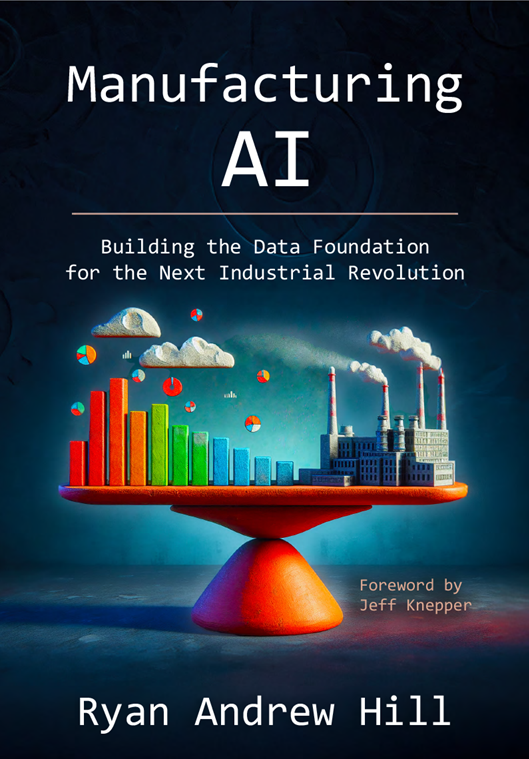
An Industry 4.0 practitioner focused on data, automation, and AI, he built UMDA to give teams an open, vendor-neutral way to unify their data so analytics and AI finally have the context they need. His book goes deeper on building that foundation.
Credits
Acknowledgements
We're indebted to the standards bodies, communities, and pioneers whose work UMDA builds on, including Walker Reynolds (Unified Namespace), Arlen Nipper and Andy Stanford-Clark (MQTT), Zhamak Dehghani (Data Mesh), and the first manufacturers who proved UMDA on real lines with real deadlines.
Help make UMDA a shared standard
Adopt the framework, extend it for your operations, and pass it on. The more it's used, the stronger it gets.